
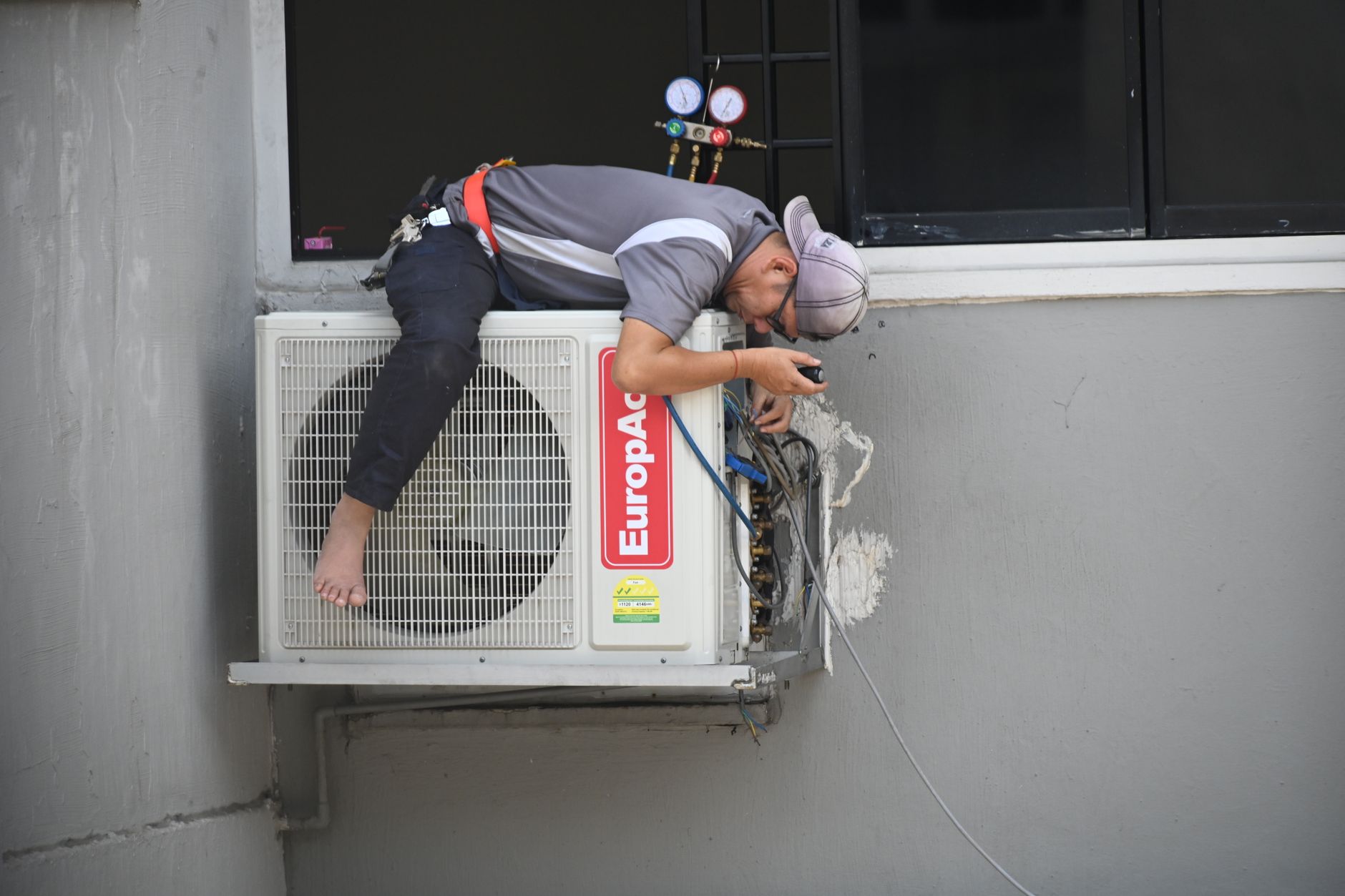
A proper AC maintenance checklist for Dubai should cover 15 tasks: filter cleaning, evaporator coil chemical clean, condenser coil pressure-wash, condensate drain flush with biocide, refrigerant pressure verification, capacitor testing, electrical connection check, blower wheel clean, duct inspection, thermostat calibration, outdoor unit clearance check, drain pan inspection, insulation and sealing audit, smart thermostat upgrade assessment, and a replacement decision review for ageing units. Done in March or April, this programme typically reduces peak summer DEWA bills by 20–35% on neglected units and eliminates the most common failure modes before emergency rates apply.
Why Dubai AC Maintenance Is Different
A maintenance schedule written for the UK or Singapore does not translate to Dubai. Split AC systems here run 10–14 hours per day from June through September, ambient temperatures exceed 45°C, and the air carries fine particulate sand that infiltrates every unsealed gap. Standard filter-and-go servicing is not sufficient preparation.
In a single Dubai summer, a residential split unit accumulates roughly three years of equivalent wear compared to a temperate climate. The most common failure modes — dirty evaporator coils, blocked condensate drains, degraded capacitors, and clogged condenser fins — are all directly linked to the Dubai operating environment and are all preventable with a structured pre-season programme.
A homeowner in Jumeirah spotted a faint water stain below his indoor unit in July and decided to monitor it. The condensate drain had been partially blocked since the previous winter. By the time he called, the drain pan had been overflowing nightly for 12 days. The gypsum ceiling below required full replacement: AED 4,200 in reinstatement work, in addition to the service visit that would have cost AED 350 in April. The blockage had been forming for months and would have taken 30 seconds to flush. Preventive maintenance always costs less than emergency repair. The only variable is how much less.
The Complete AC Maintenance Checklist for Dubai
Items marked [DIY] can be handled safely by most homeowners. Items marked [Tech] require a licensed HVAC technician with the correct equipment, chemicals, and — for refrigerant work — a DEWA-recognised qualification.
1. Clean or Replace Air Filters [DIY]
Filters are the highest-frequency maintenance task and the most commonly skipped. In Dubai, clean or replace every 4–6 weeks during peak summer (every 2–4 weeks if the property is near a construction site). Standard advice from temperate climates suggests three months — that interval is inadequate here.
- Washable foam filters: Remove, rinse under warm water with mild detergent, rinse thoroughly until water runs clear, and allow to dry completely in shade before reinstalling. A wet filter reinstalled in a running unit will block airflow entirely.
- Disposable fibreglass or pleated filters: Replace when visibly grey or when media is clearly loaded. Do not attempt to wash them — the fibres break down and particles pass through directly onto the evaporator coil.
A blocked filter increases electricity consumption by 15–20% and, in severe cases, causes the evaporator coil to ice over, cutting cooling output to near zero. It is also the leading cause of the complaint "AC is running but the room is not cooling."
2. Chemical Clean the Evaporator Coil [Tech]
The evaporator coil is the aluminium fin-and-tube assembly inside the indoor unit. Over one Dubai season it accumulates dust, construction particulate, skin particles, and microbial growth that cannot be removed with a brush or cloth. This layer acts as insulation, preventing refrigerant from absorbing heat from the air and forcing the compressor into longer cycles.
Professional coil cleaning uses a foaming chemical agent that penetrates between fins, dissolves biological matter, and drains out through the condensate line. On severely dirty units — those not cleaned in 18 or more months — this single task restores 20–30% cooling capacity. It is not a DIY task: the wrong product or concentration can corrode aluminium fins permanently, converting a AED 400 service call into a AED 2,500 coil replacement.
3. Flush and Treat the Condensate Drain Line [Tech]
The condensate line removes water produced by the evaporator coil — typically 8–15 litres per day during peak summer — from the building. Dubai's warm internal conditions encourage algae to colonise the drain at any slow u-bend or connection point until the line blocks completely.
When the drain blocks, the pan overflows into the ceiling or wall. A biocide flush at every service visit takes under a minute and prevents this entirely. Some technicians fit a slow-release biocide tablet in the drain pan for continuous protection between visits.
Signs the drain is partially blocking: water dripping from the bottom of the indoor unit, a musty smell when the AC runs, or moisture staining below the unit on the wall or ceiling.
4. Pressure-Wash and Chemical Clean the Condenser Coil (Outdoor Unit) [Tech]
The outdoor condenser rejects heat from the refrigerant into the outside air. Dubai's sand and dust cake onto the condenser fins far faster than in most environments — and construction dust, which contains calcium compounds, is harder to remove than ordinary sand once it has dried and set.
A blocked condenser cannot reject heat efficiently. Refrigerant returns to the compressor too warm, discharge pressure rises, and the system either underperforms or trips on high-pressure protection. Annual pressure-washing and chemical cleaning of the condenser is among the highest-ROI tasks in a Dubai AC programme, and one frequently omitted by lower-cost providers.
5. Check Refrigerant Pressure with Manifold Gauges [Tech]
A correctly installed and sealed system should never need a refrigerant top-up. If pressure is low, refrigerant has escaped — meaning there is a leak that must be found and repaired first. Be cautious of technicians who top up refrigerant without a prior leak test: the charge will escape again within weeks and the underlying damage continues.
A proper check involves attaching manifold gauges to the service ports, reading suction and discharge pressures, and comparing them against manufacturer specification at current ambient temperature. If pressure is within spec, no further action is needed. If low, the technician should perform an electronic or nitrogen-pressure leak test before adding any refrigerant. This task requires a DEWA-recognised qualification for F-gas handling.
6. Inspect and Test Electrical Capacitors [Tech]
Start and run capacitors degrade faster at sustained high ambient temperatures — exactly the conditions Dubai provides for four consecutive months. A failing capacitor causes the compressor or fan motor to struggle at start-up, draw excess current, and eventually fail to start at all.
A technician can test capacitor condition with a capacitance meter in two minutes. Replacing one measuring outside tolerance — typically a AED 150–350 part as a planned replacement — prevents a AED 350–500 emergency callout fee plus the same part cost at emergency markup, plus the risk that the failed capacitor takes the compressor with it (a AED 1,500–3,500 component).
7. Inspect All Electrical Connections and the Contactor [Tech]
Vibration and thermal cycling cause connection terminals to loosen over time. Loose connections create resistance, which creates heat, which accelerates insulation degradation. An annual inspection — tightening any loose terminals and checking for discolouration indicating past arcing — takes minutes and prevents a category of failures that can cause component damage or, in extreme cases, fire.
The contactor (the relay that switches compressor power) has a finite cycle life. Pitting on the contact faces indicates it is approaching end of life and warrants replacement before it fails mid-summer.
8. Clean the Blower Wheel [Tech]
The blower wheel — the squirrel-cage fan inside the indoor unit — accumulates a ring of sticky dust and microbial matter that gradually reduces airflow and generates odour. In Dubai, this build-up can become significant within a single season if filters have been even partially neglected.
A dirty blower wheel reduces airflow by 15–25%, making the system noticeably less effective despite all other components being in sound condition. Blower wheel cleaning requires removal from the housing and is part of a full-service visit — it is not the same as filter cleaning and is frequently omitted by lower-cost providers quoting "full service."
9. Inspect and Clean Ductwork (Central Systems) [Tech]
For properties with ducted central AC systems, annual duct inspection is warranted. Dubai's dusty environment, combined with the volume of air circulated by a villa central system, means significant particulate accumulation is possible within two to three seasons. Beyond the air quality implications, heavily fouled ductwork reduces system airflow and increases fan energy consumption.
A duct inspection should also identify any sections with loose joints or collapsed insulation — both common in buildings where the original installation was completed under time pressure. Loose duct joints allow conditioned air to leak into ceiling voids, increasing running costs without improving comfort.
10. Calibrate or Replace the Thermostat [DIY / Tech]
Digital thermostats drift over time, particularly when exposed to direct sunlight or heat sources. A 1.5°C miscalibration results in approximately 10% higher energy use — the system runs longer cycles chasing a temperature it believes has not been reached. Check calibration with a calibrated reference thermometer placed at thermostat height. DEWA recommends 24°C as the optimal efficiency setting; every degree below this adds approximately 6% to AC energy consumption.
If you are still using a basic non-programmable thermostat, the upgrade to a programmable or smart thermostat (AED 200–600 installed) typically pays back within one summer through better scheduling and setback during unoccupied hours.
11. Clear the Outdoor Unit and Inspect for Physical Damage [DIY]
The outdoor condenser needs clear airflow to reject heat. The top-mounted fan draws air through the side fins and exhausts it vertically upward — any obstruction above the fan or blocking the inlet grilles reduces efficiency significantly.
- Maintain at least 60 cm clearance on all sides of the outdoor unit
- Maintain at least 120 cm above the fan outlet
- Remove stored materials, potted plants, or construction debris from the immediate area
- Check that fan blades are intact and that no debris has entered through the top grille
- Check fins for physical damage — bent fins can be straightened with a fin comb
Dubai's shamal wind events (March–May and September–October) can deposit significant sand and debris into outdoor units. A monthly visual check costs nothing and catches problems before they reduce efficiency.
12. Inspect the Indoor Unit Drain Pan [DIY / Tech]
The plastic drain pan below the evaporator coil can crack or warp after several years of heat cycling. A cracked pan leaks water even when the drain line is entirely clear. Inspect for cracks, discolouration, and standing water at each service visit. Higher-specification units include a float switch that shuts the system down if the pan fills — verify this switch is functioning if your unit has one.
13. Check Building Insulation and Sealing [DIY]
Gaps around cable penetrations, pipe entries, and poorly fitted door seals allow hot outside air to infiltrate directly into conditioned spaces. In Dubai, where outside temperatures in summer can be 25°C above indoor target temperatures, a gap of a few centimetres around a cable entry point creates a measurable additional load on the AC system.
A walk-around inspection with your hand near potential gap locations — window frames, external door seals, cable and pipe penetrations — identifies the worst offenders. Foam sealant or weatherstripping from a hardware store costs under AED 50 and reduces AC load more directly than most other interventions available to a homeowner.
14. Assess Whether to Upgrade to an Inverter Unit [DIY Consideration]
Modern inverter AC units are 30–50% more energy-efficient than equivalent non-inverter units from the previous decade. At Dubai's summer electricity tariffs (Slab 3: AED 0.38/kWh for consumption above 4,000 kWh/month), the running cost differential is significant over a full summer season.
If a unit is over 10 years old, requires increasing repair frequency, or uses R-22 refrigerant (phased out globally and now sourced only from reclaimed stock at premium cost), the calculation often favours replacement over continued repair. A unit requiring more than AED 1,500 in repairs in a single season that is more than 8 years old rarely justifies the spend versus a new inverter unit.
15. Review Your Annual Maintenance Contract Coverage [DIY Consideration]
An Annual Maintenance Contract (AMC) covering 2–4 scheduled visits per year, parts discounts, and emergency-callout priority costs AED 2,500–5,500 for a standard Dubai villa with 4–6 split units. This typically costs less than two emergency callout visits and guarantees scheduling priority in the peak summer period, when non-AMC clients face 5–10 day waits and emergency-rate premiums.
Pre-summer — before the service queue forms — is the correct time to put a contract in place, not after the first August breakdown.
Pre-Summer AC Maintenance: Optimal Timeline
Timing determines both availability and cost. Dubai's HVAC companies experience significant demand spikes from late May as temperatures climb and emergency calls begin. The window for pre-summer servicing at normal rates and short lead times is March to late April.
- February–March: Book your service. Availability is good and companies are not yet at emergency-call capacity
- April: Ideal service timing — moderate ambient temperatures allow accurate system performance testing under near-realistic load
- May: Still worthwhile, but booking windows are narrowing. Expect 5–10 day lead times with reputable companies
- June onwards: Emergency season. Expect 2–5 day lead times for non-urgent work and AED 300–500 premium callout fees for same-day service on top of parts and labour
What Does a Professional AC Service Cost in Dubai?
Indicative market rates as of 2026:
- Basic filter clean and visual check: AED 150–250 per unit — insufficient for pre-summer preparation
- Standard full service (coil chemical clean, condensate flush, refrigerant pressure check, electrical inspection): AED 300–600 per unit
- Comprehensive service including blower wheel clean and duct inspection: AED 400–700 per unit
- AMC covering 2–4 visits per year, parts discounts, and emergency priority: AED 2,500–5,500 for a Dubai villa with 4–6 units
When comparing quotes, confirm exactly what is included. A basic filter clean quoted as a "full service" is a common source of disappointment — and it leaves the most impactful tasks undone.
How Much Can AC Maintenance Reduce Your DEWA Bill?
The savings are real and measurable. Across AMC properties with logged before-and-after consumption data:
- Filter cleaning alone on a previously blocked unit: 8–15% consumption reduction
- Evaporator coil chemical clean on a heavily fouled unit: 15–25% reduction
- Combined full service on a well-maintained unit: 5–12% reduction
- Combined full service on a neglected unit (last serviced 18+ months prior): 20–35% reduction
For a Dubai apartment running two split units, a full pre-summer service typically reduces monthly DEWA bills by AED 100–250 during peak months. For a villa with 4–6 units, savings of AED 300–600 per month across June–September are realistic. At those figures, the service cost is recovered within 4–6 weeks of summer.
Frequently Asked Questions
When is the best time to service my AC before Dubai summer?
March to late April is the optimal window. Ambient temperatures are moderate enough to test system performance accurately, and HVAC companies are not yet at emergency-call capacity. Booking in April means 1–3 day lead times rather than the 5–10 day waits that become common from late May. By June, same-day emergency rates apply to urgent visits.
How often should I service my AC in Dubai?
At minimum: one full professional service before summer (April) and one after summer (October–November). For units in high-use rooms or near significant construction activity, quarterly filter cleaning plus two professional full-service visits per year is the better programme. AMC clients receive 2–4 scheduled visits annually depending on the plan selected.
How much does an AC service cost in Dubai?
A full pre-summer service — coil chemical clean, condensate flush with biocide, refrigerant pressure check, capacitor test, and electrical inspection — costs AED 300–600 per unit with a reputable company. A basic filter clean and visual check costs AED 150–250 but is not adequate preparation for Dubai summer. A villa AMC covering 4–6 units (AED 2,500–5,500 per year) typically costs less than two emergency callout visits.
What happens if I do not service my AC before Dubai summer?
Most likely outcomes: higher DEWA bills (a dirty system typically uses 20–35% more electricity), reduced cooling performance during the hottest weeks, and elevated breakdown risk in August — peak temperature month with the longest service queues. A capacitor replaced as a planned task costs AED 150–350. The same failure in August includes a AED 350–500 emergency callout fee, parts at emergency markup, and potentially 24–48 hours without cooling during temperatures above 45°C.
What can I do myself versus what needs a technician?
Safe DIY tasks: filter cleaning or replacement, wiping the external housing, clearing debris from around the outdoor unit, checking thermostat settings, and sealing obvious gaps around windows and cable entries. Tasks requiring a licensed technician: evaporator and condenser coil chemical cleaning, refrigerant pressure checks and leak testing (requires DEWA-recognised qualification), capacitor testing, electrical connection inspection, and blower wheel cleaning. Attempting coil cleaning with incorrect products can permanently corrode aluminium fins.
Does my AC need a refrigerant top-up every year?
No. A correctly installed and sealed system never needs a refrigerant top-up — it uses the same charge indefinitely. If pressure is low, refrigerant has escaped through a leak that must be found and repaired first. Technicians who top up refrigerant without a prior leak test are addressing the symptom, not the cause. Signs of low refrigerant include continuous running without reaching set temperature, ice forming on the indoor unit, and hissing or bubbling sounds near the outdoor unit.
Should I get my AC ducts cleaned in Dubai?
For ducted central AC systems in Dubai villas, duct cleaning every 2–3 years is warranted given the volume of airborne particulate. For individual split units (which have no ductwork), the equivalent task is evaporator coil and blower wheel cleaning. Signs that duct cleaning is overdue: visible dust being discharged from vents, a persistent smell even after coil cleaning, or noticeably reduced airflow from certain outlets. Duct cleaning for a villa typically costs AED 800–2,000 depending on the number of outlets and system size.
How long does a professional AC service take?
A full-service visit for one split unit (indoor and outdoor) takes approximately 60–90 minutes with an experienced technician. A villa with 4–6 units should expect a half-day visit of 4–5 hours. If blower wheel cleaning is included, add 20–30 minutes per unit. Booking a morning slot is generally better — technicians are fresh and there is time to address unexpected findings without rushing into the afternoon.
Is it worth upgrading to a smart thermostat in Dubai?
Yes, particularly for properties with irregular occupancy patterns. A programmable or smart thermostat (AED 200–600 installed) allows setback scheduling during work hours and pre-cooling before occupancy, reducing the system's run time without sacrificing comfort on arrival. At Dubai's summer electricity tariffs, reducing daily AC runtime by even 1–2 hours typically pays back the thermostat cost within a single summer season.