
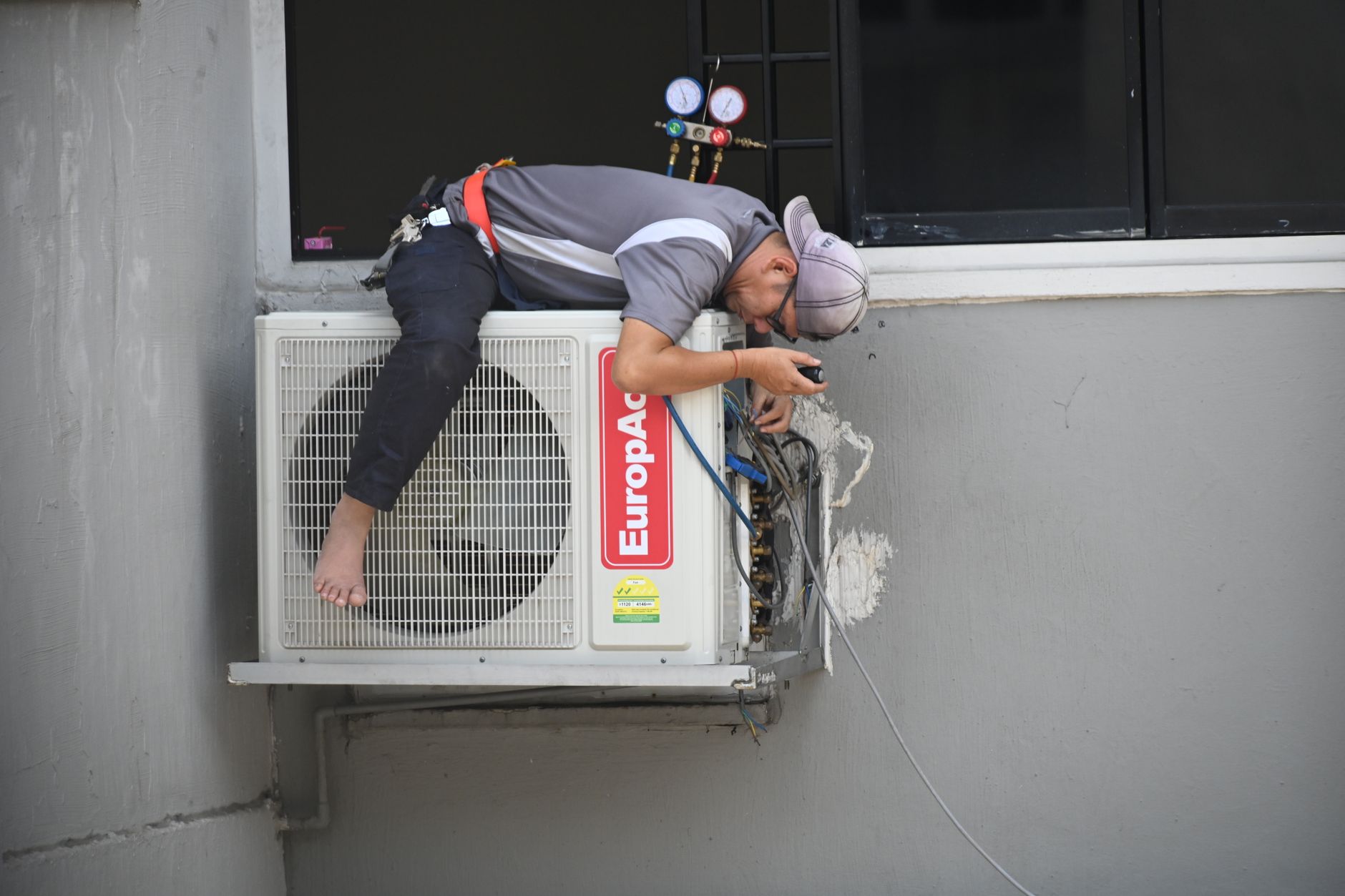
AC duct cleaning in Dubai costs AED 550–875 per unit for a professional service, and for most Dubai properties the answer to "do I need it?" is yes — typically every 12 to 18 months. Dubai's combination of extreme atmospheric dust, near-continuous AC operation, and sealed building envelopes creates duct contamination conditions that are significantly more severe than in most cities. The question is not usually whether your ducts need cleaning, but how badly.
Why Dubai Is Harder on AC Ducts Than Most Cities
Dubai's atmospheric particulate concentration is among the highest of any major global city. Shamal wind events carry ultra-fine desert sand particles that pass straight through standard AC filters and accumulate on duct walls, coils, and fans over months of continuous operation. During Dubai's summer, the AC runs 18 to 24 hours a day — there is no "off season" during which contamination can be assessed and addressed at leisure.
The sealed nature of modern Dubai buildings compounds the problem. Properties designed for energy efficiency have minimal natural air exchange, which means indoor air is recycled through the duct system repeatedly throughout the day. Whatever is in those ducts is in the air your family breathes — continuously, and in concentrations that accumulate over time.
Add to this the transition-season humidity (October to November and March to April), when Dubai's relative humidity spikes and the cooling coil runs warm enough to support microbial growth, and you have the conditions for mould and bacteria to establish in the duct system before the summer heat cycle resumes.
What Accumulates in Dubai AC Ducts
Fine Sand and Particulate
The fine particles that pass through standard AC filters coat duct walls with a layer that thickens over time. Visually, this looks like a grey film inside the duct. Functionally, it narrows the duct cross-section, increases airflow resistance, and provides a substrate for microbial growth. In Dubai's conditions, a property with no duct cleaning history can accumulate a measurable particulate layer within 18 months.
Mould and Microbial Growth
The evaporator coil in a split AC unit operates at temperatures that support condensation — that moisture, combined with accumulated organic material in the duct, creates an environment where mould and bacteria can establish. Systems that are not regularly serviced and coil-cleaned are particularly prone to this. The musty smell when you first switch on the AC after it has been off for several hours is almost always microbial — you are smelling the result of biological activity in the coil and duct.
Allergens and Biological Material
Dubai's year-round dust carries regional pollen types, and in properties where the AC operates continuously, these accumulate in duct systems rather than being filtered out or diluted by fresh air. In older buildings, poorly sealed duct penetrations can allow insect activity — and the biological material left behind is then distributed through the air supply.
Volatile Organic Compounds (VOCs)
In sealed Dubai apartments, VOCs from furniture off-gassing, cleaning products, and construction materials accumulate in indoor air without the dilution effect of natural ventilation. While duct cleaning does not remove VOCs directly, it improves the overall air exchange efficiency of the system, and post-renovation duct cleaning removes the construction particulate that traps VOC-bearing particles on duct surfaces.
Signs Your Ducts Need Professional Cleaning Now
- Dust reappears on supply registers within days of cleaning — the AC is blowing contamination back out as fast as you wipe it
- Musty or stale smell when the AC starts up, particularly after the system has been off for several hours — microbial activity in the coil or duct
- Household members with persistent respiratory symptoms — coughing, sneezing, or fatigue that improves when away from home
- Visible mould growth around supply registers or on the indoor unit face
- Rising electricity bills without increased usage — particulate on coils and duct walls forces the system to work harder
- Recent renovation work — construction generates substantial fine particulate that enters duct systems through return grilles and unsealed penetrations
- No duct cleaning in the past 18 months — in Dubai's conditions, this is sufficient reason on its own
- Recently moved into the property — the duct history of a new-to-you property is unknown; inspection before occupation is always worthwhile
What a Professional AC Duct Cleaning Service Involves
A properly executed duct cleaning service is not a simple filter rinse. The process should involve five distinct stages:
Step 1: Inspection
Camera inspection of accessible duct runs to assess contamination levels, identify any mould growth, and confirm duct integrity before cleaning commences. This step determines the cleaning method and scope — a heavily contaminated system requires a different approach from one with light particulate build-up.
Step 2: Mechanical Agitation
Rotating brush systems — specifically, machines such as the Rotobrush, which carries spinning brush attachments on a flexible cable — dislodge accumulated particulate from duct walls. This step must precede extraction; without agitation, a vacuum alone will not remove bonded deposits.
Step 3: Negative Pressure Extraction
A HEPA-filtered extraction unit is connected to the duct system, creating negative pressure that captures all dislodged material rather than redistributing it into the room. The HEPA requirement is not a marketing add-on — without HEPA filtration, fine particulate is simply moved from the duct to the extraction unit's exhaust and back into the indoor air.
Step 4: Coil Cleaning
The evaporator coil is the primary site of microbial growth in any AC system. Chemical coil cleaning — using a suitable foaming agent to break down organic deposits — addresses the source of contamination rather than just its downstream effects in the duct. Any duct cleaning service that does not include coil cleaning is incomplete.
Step 5: Sanitisation
Application of an antimicrobial fogging agent — ideally an EPA-registered or equivalent product — kills mould spores and bacteria remaining after mechanical cleaning and leaves a protective coating on duct surfaces that inhibits regrowth. The sanitisation step is what differentiates a professional service from a mechanical clean.
AC Duct Cleaning Dubai: Costs in 2026
Professional duct cleaning pricing in Dubai varies by provider and property type. Realistic ranges based on current market rates:
- Per-unit duct cleaning (premium service): AED 550–875 per unit
- Studio or one-bedroom apartment (1–2 units): AED 800–1,400
- Two to three-bedroom apartment (2–4 units): AED 1,000–2,000
- Three to four-bedroom villa (4–6 units): AED 1,500–3,500
- Central ducted villa system: AED 1,800–4,000+ depending on duct extent and access
Services priced at the lower end of these ranges typically cover mechanical cleaning only. Services at the upper end include camera inspection, coil cleaning, and sanitisation — the complete process. For Dubai's conditions, the complete process is the right benchmark.
How Often Should AC Ducts Be Cleaned in Dubai
The standard international guidance — cleaning every three to five years — is not appropriate for Dubai. Local conditions warrant:
- Camera inspection: every 12 months, ideally before summer
- Full duct cleaning and sanitisation: every 12–18 months for most properties
- Every 12 months: properties with young children, elderly residents, or occupants with respiratory conditions; properties with pets; older buildings with known dust ingress issues
- Immediately: after any renovation work; when moving into a new-to-you property; when visible mould is present
The "every 6 months" recommendation seen from some Dubai providers is appropriate for high-occupancy commercial properties or properties with serious contamination history, but is more frequent than necessary for most well-maintained residential properties.
What Dirty Ducts Do to Your DEWA Bill
The energy efficiency case for duct cleaning is straightforward and often underappreciated. Particulate build-up on duct walls increases airflow resistance, forcing the AC fan motor to draw more power to maintain the same airflow. A contaminated evaporator coil significantly reduces the heat transfer efficiency of the refrigeration cycle — the coil cannot shed heat effectively when its surface is coated with biological material and dust.
The combined effect of dirty ducts and a contaminated coil can add 10–20% to AC energy consumption. For a Dubai villa running four to six AC units through a six-month summer at DEWA rates, that represents AED 600–1,800 in additional electricity cost per year — a meaningful contribution toward the cost of the cleaning service itself.
Indoor Air Quality Testing: When to Go Further
For properties where occupants have persistent symptoms despite duct cleaning, or where significant mould growth has been identified, professional indoor air quality testing provides a baseline measurement that guides further action. IAQ testing in Dubai typically measures:
- Particulate matter (PM2.5 and PM10)
- Carbon dioxide concentration (indicator of ventilation adequacy)
- Total volatile organic compounds (TVOCs)
- Mould spore counts
- Temperature and relative humidity
IAQ testing is particularly relevant for properties that have undergone recent renovation, buildings over 10 years old with known maintenance deficiencies, and households with occupants diagnosed with asthma or severe allergies.
What Duct Cleaning Cannot Fix
Duct cleaning addresses contamination within the duct system — it does not fix the conditions that caused that contamination. If your AC system is not being regularly serviced (coil cleaning, filter maintenance, drain clearance), duct contamination will return quickly after cleaning. If your building envelope has gaps that allow sand ingress, cleaning provides temporary relief rather than a permanent solution.
Duct cleaning is most effective as part of a broader maintenance approach: quarterly AC servicing to prevent contamination at source, combined with duct cleaning every 12 to 18 months to address what quarterly servicing cannot reach. This is why duct cleaning is included as an add-on option in comprehensive AMC packages — it works best in context, not as a standalone one-off.
Improving Indoor Air Quality Beyond Duct Cleaning
Duct cleaning is the most impactful single action for most Dubai properties, but indoor air quality is also affected by:
- AC filter maintenance: Filters should be cleaned or replaced monthly during peak summer operation — a clogged filter reduces both air quality and system efficiency
- Kitchen and bathroom exhaust fans: These should exhaust to the outside, not recirculate; a failed exhaust fan in a sealed apartment significantly raises indoor humidity and cooking VOC levels
- Fresh air intake: During cooler months (October to April), opening AC fresh air dampers dilutes indoor air pollutants that have accumulated during the sealed summer period
- HEPA air purifiers: In bedrooms occupied by people with respiratory sensitivities, a HEPA purifier supplements AC filtration for sleep hours
- VOC sources: New furniture, spray paints, and strong solvents off-gas significantly in sealed environments — ventilate or remove these sources where possible
Frequently Asked Questions
How often should AC ducts be cleaned in Dubai?
For most Dubai residential properties, a full duct clean and sanitisation every 12–18 months is appropriate, with a camera inspection annually before summer. Properties with young children, elderly residents, occupants with respiratory conditions, or pets should clean every 12 months. Post-renovation cleaning should happen immediately after any building work, regardless of when the previous clean occurred.
How much does AC duct cleaning cost in Dubai?
A professional duct cleaning service in Dubai costs AED 550–875 per AC unit for a complete service including inspection, mechanical cleaning, coil cleaning, and sanitisation. For a typical two to three-bedroom apartment (two to four units), expect AED 1,000–2,000. For a villa with four to six units, AED 1,500–3,500. Services priced below these ranges typically cover mechanical cleaning only, without coil treatment or sanitisation.
What happens if I do not clean my AC ducts?
In Dubai's conditions, contamination accumulates steadily — increasing airflow resistance (which raises electricity bills by 10–20%), providing a substrate for mould and bacteria growth in the duct and coil, and circulating allergens and fine particulate through your indoor air continuously. Over time, a heavily contaminated system can contribute to respiratory symptoms in household members and risks microbial growth reaching levels that require more intensive remediation.
How does professional AC duct cleaning work?
A proper service involves five stages: camera inspection to assess contamination; mechanical agitation using rotating brush equipment to dislodge deposits from duct walls; negative-pressure HEPA extraction to capture dislodged material; chemical coil cleaning to remove biological deposits from the evaporator coil; and antimicrobial sanitisation fogging to inhibit regrowth. The entire process for a typical apartment takes two to four hours; villas with multiple units and extended duct runs take four to six hours.
Can dirty ducts cause health problems?
In Dubai's sealed, continuously air-conditioned environment, duct contamination — particularly mould growth and accumulated allergens — can contribute to respiratory irritation, allergy exacerbation, and in cases of significant mould, more serious symptoms. A useful diagnostic: if household members experience persistent coughing, sneezing, or fatigue that improves when away from home for extended periods, duct contamination is worth investigating as a contributing factor.
Will duct cleaning remove the musty smell from my AC?
Yes, in most cases. The musty smell that occurs when an AC starts up — particularly after the system has been off for several hours — is almost always caused by microbial growth on the evaporator coil or in the duct. A proper service that includes coil cleaning and antimicrobial sanitisation addresses this at the source. If the smell persists after a full service, it may indicate a drain pan issue or mould growth outside the duct system, which requires separate investigation.
Is duct cleaning covered by a True Guard AMC?
Full duct cleaning is available as an add-on to any True Guard AMC, or as a standalone service. Our standard AMC includes coil cleaning at every quarterly service visit, which addresses the primary site of microbial contamination. Full duct cleaning every 12–18 months is recommended for families with young children, elderly residents, or occupants with respiratory conditions, and is included at a discount rate for AMC clients.
How long does AC duct cleaning take in Dubai?
A professional duct cleaning service for a two to three-bedroom apartment typically takes two to four hours. A villa with four to six AC units takes four to six hours. Central ducted systems with extensive duct runs can take a full day. The time varies based on the number of units, the extent of contamination, and duct access — heavily contaminated systems require more time in the mechanical agitation stage.