
A bathroom renovation in Dubai costs anywhere from AED 8,000 to well over AED 180,000 — a range wide enough to be nearly useless without context. The actual cost depends on three things: the size of the room, the finish level, and whether drain positions or walls are moving (which requires breaking concrete and adds both cost and time). This guide gives you real 2026 cost data, the design directions Dubai homeowners are choosing, and the process knowledge that keeps a bathroom renovation from becoming a waterproofing problem two years later.
Bathroom Renovation Cost in Dubai: Full Breakdown (2026)
The three tiers below reflect realistic market ranges for a standard Dubai bathroom — approximately 6–10 sqm. Larger master bathrooms scale upward; small guest bathrooms or en-suites scale down.
Budget Renovation: AED 8,000–20,000
What this covers in a straightforward retile-and-replace project:
- New toilet suite (close-coupled, standard range)
- New basin with freestanding or semi-recessed vanity unit
- New shower enclosure and tray, or bath with screen
- Retile using mid-range ceramic or porcelain (up to 60×60cm format)
- Standard mixer tap and shower fitting
- LED ceiling downlights
- New mirror or mirror cabinet
This tier is appropriate for rental investment properties, secondary bathrooms, or any scenario where the existing plumbing layout is being retained exactly as it is. The moment drains move, this budget tier is no longer realistic.
Mid-Range Renovation: AED 20,000–55,000
What typically upgrades at this level:
- Premium rectified large-format porcelain tile — 600×600mm or larger, often 600×1200mm or 900×900mm
- Custom or semi-custom vanity with quartz or stone countertop
- Wall-hung toilet with concealed cistern (Geberit or Grohe frame)
- Frameless glass shower enclosure, or fully tiled wet room with linear drain
- Quality shower and tap system — Grohe, Hansgrohe, or equivalent
- Recessed ceiling lighting and backlit or LED-framed mirror
- Heated towel rail
- Mosaic or feature tile accent panel
This is the most common specification for primary bathrooms in Emirates Hills, Arabian Ranches, Dubai Hills, and Jumeirah villa communities. It delivers a result that looks genuinely premium while remaining cost-effective at scale for multi-bathroom renovation projects.
Luxury Renovation: AED 60,000–180,000+
The specifications that characterise luxury bathroom renovations in Dubai:
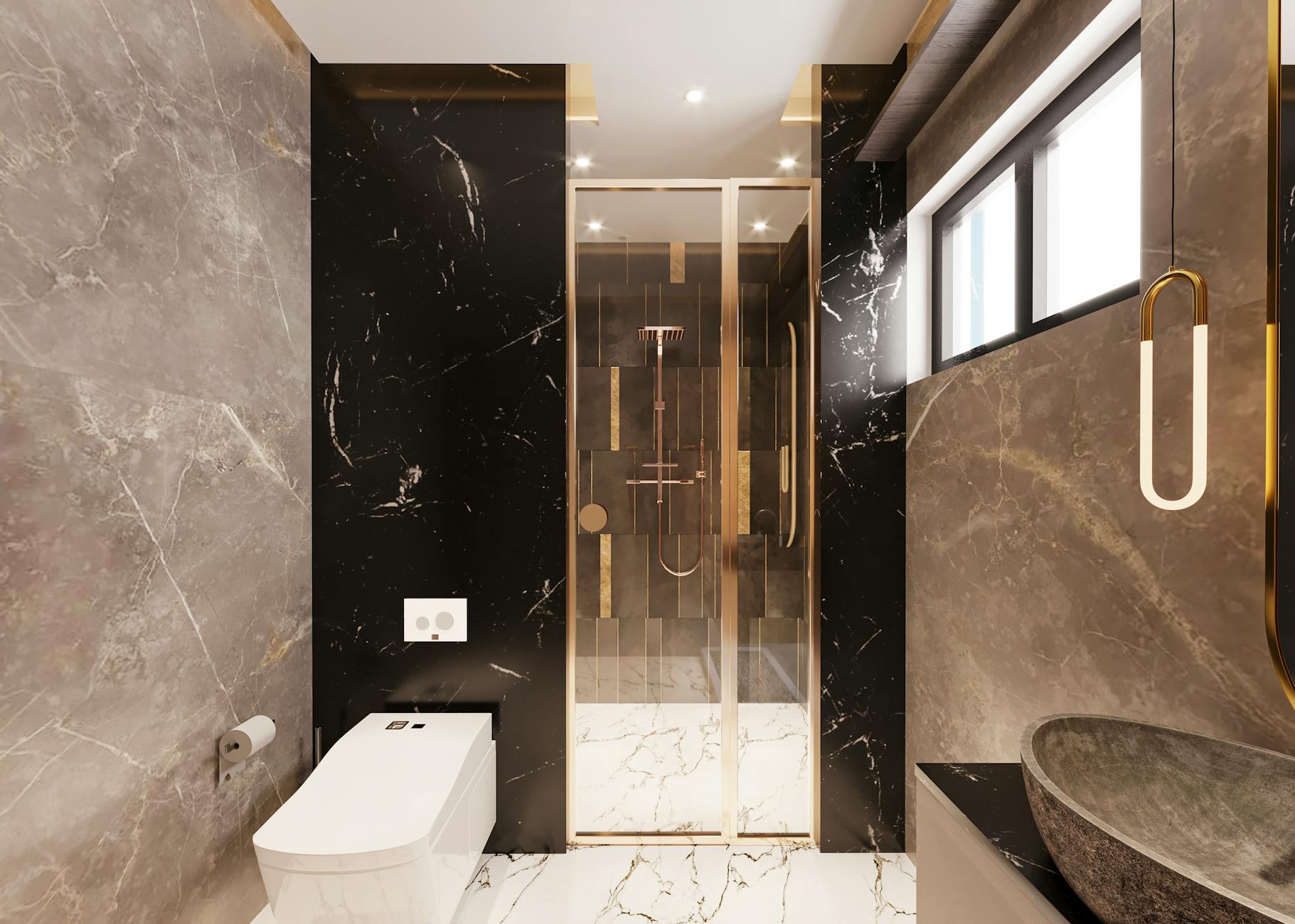
- Natural stone throughout — Italian marble (Calacatta, Statuario, Volakas), Turkish travertine, or bookmatched feature walls
- Freestanding bath in resin composite, copper, or acrylic
- Designer fixtures: AXOR, Fantini, THG Paris, or Vola
- Electric underfloor heating mat system
- Integrated steam or multi-function shower (Kohler, Duravit, Villeroy & Boch)
- Custom solid-wood or lacquered vanity unit with bespoke lighting
- Smart toilet (TOTO Washlet, DURAVIT SensoWash, or Geberit AquaClean)
- Programmable mood lighting and bespoke mirror with integrated backlight
Cost by Scope: Labour Only vs Full Supply and Fit
Some owners choose to supply their own tiles and sanitary ware and pay a contractor for labour and installation only. Labour-only bathroom renovation in Dubai starts from approximately AED 9,500–14,000 for a standard bathroom — but this arrangement transfers material responsibility entirely to you, including ordering the right quantities, managing delivery timing, and accepting that most contractors will not warranty tile work on client-supplied materials. It is viable if you are experienced in managing material procurement; otherwise the administrative complexity rarely justifies the saving.
Minor Works Pricing Guide
- Bath-to-shower conversion: AED 5,500–12,000
- Sanitary ware replacement only (toilet, basin, taps): AED 3,500–8,000
- Regrouting a standard bathroom: AED 1,500–3,500
- Waterproofing re-treatment of shower area: AED 2,500–6,000
- Vanity unit replacement: AED 2,500–8,000
Bathroom Renovation Trends in Dubai: What Homeowners Are Choosing in 2026
Large-Format Stone-Look Porcelain
The most significant shift in Dubai bathroom design over the past three years is away from small-format mosaic and feature tiles toward continuous large-format stone-look porcelain — 900×1800mm slabs and larger are now common in master bathrooms. These tiles create a seamless, spa-like aesthetic, read significantly more premium than small-format tiling, and are dramatically easier to maintain with fewer grout lines to clean. Italian manufacturers — Fioranese, Rex Ceramiche, Atlas Concorde, and Italgraniti — produce marble-effect porcelain at a fraction of natural stone cost with superior durability and stain resistance in wet environments.
Wet Rooms Over Shower Enclosures
The frameless, doorless wet room — a completely waterproofed continuous zone with a linear drain set flush to the floor — has become the dominant shower format in Dubai villa master bathrooms. Practical benefits: easier daily cleaning, no shower door track or seal to maintain, more accessible for long-term living, and a more open, spacious visual result. The waterproofing installation must be done correctly — a single shortcut here creates years of costly problems. The wet room is not a lower-cost option than a glass enclosure; it is a higher-quality outcome that requires more careful installation.
Wall-Hung Fixtures and Floating Vanities
Wall-hung toilets with concealed cisterns and floating vanity units are now standard in mid-range and above Dubai bathroom renovations. The practical benefits are real: easier floor cleaning, a visually larger floor area, and a suspended design that works well in modern interiors. A wall-hung toilet requires a concealed cistern frame built into the wall — this must be planned from the start, as it needs structural wall access before tiling and cannot be easily retrofitted.
Calacatta and Marble-Effect Aesthetics
The white-and-grey veined marble aesthetic remains Dubai's dominant luxury bathroom direction. Whether specified as genuine Italian marble or high-quality Italian porcelain replicating it, the Calacatta and Statuario look continues to command strong buyer response. For mid-range projects, the porcelain alternatives offer the aesthetic at a fraction of the natural stone cost — with the added practical advantage of being harder, non-porous, and significantly more resistant to soap scum and cleaning products.
Matte Black and Brushed Gold Hardware
Chrome is being consistently replaced by matte black and brushed gold (PVD-coated brass) as the dominant hardware finish. Both show far fewer water marks than polished chrome — a significant practical benefit in Dubai's hard water environment — and create a stronger design statement. Matte black reads more contemporary and industrial; brushed gold reads warmer and more classic. Both photograph well for listing and resale purposes, which matters more than many owners initially expect.
Spa-Inspired Wellness Features
Rain showers, built-in steam generators, heated floors, and integrated audio are increasingly incorporated into full master bathroom renovations. The distinction worth making: a rain shower head costs AED 800–3,000 and is a straightforward upgrade; a full steam room conversion requires waterproofing of every surface, a sealed enclosure, a steam generator unit, and proper ventilation — cost range AED 20,000–50,000 for the conversion alone. Ensure you are pricing the right thing.
Earthy Palettes and Natural Texture
Warm greige, terracotta, and sand tones are gaining on the previously dominant all-white aesthetic. Wooden vanity units (teak and oak in moisture-resistant finishes), woven accessories, and stone basins are appearing in projects that want warmth rather than the clinical spa look. This direction suits natural light well — if your bathroom has a window, it is worth considering.
The Bathroom Renovation Process in Dubai
Stage 1: Design and Material Selection (Weeks 1–3)
Before any work starts, confirm these four things in writing:
- Whether drain positions are moving — if yes, concrete breaking is required, adding AED 3,000–8,000 and 3–5 extra days minimum to the programme
- Full tile selection including the specific product, format, and supplier — imported tiles from Italy or Spain can take 4–8 weeks to arrive. Order before the contractor mobilises.
- Fixture selection — European plumbing fittings sometimes require 2–6 weeks for delivery and should be on order before demolition starts
- Any structural changes such as removing a wall or relocating the entry door
Do not order tiles before the full design is confirmed. Changes to tile selection after ordering create either delay (reorder and wait) or wastage — tiles are typically non-returnable once ordered.
Stage 2: Strip-Out (Days 1–2)
All existing fixtures, tiles, and substrate removed. This is when hidden conditions are discovered: damaged waterproofing, corroded pipework behind the wall, out-of-level floors, or cement screed in poor condition. In Dubai apartments and villas built before 2010, strip-outs regularly reveal conditions that need addressing before reinstallation can begin. Budget a 15% contingency specifically for what strip-out may reveal — this is not pessimism, it is accurate budgeting based on how these buildings were constructed.
Stage 3: Plumbing Rough-In (Days 2–4)
Any new drain and supply connections are made before screeding or boarding. This stage determines all fixture positions permanently — if positions are changing, every decision must be confirmed here before any surface closes them in. Inspect and photograph all pipework before covering. This photograph, along with the waterproofing photograph, is the one you will need if you ever have a leak.
Stage 4: Waterproofing (Days 4–7)
Waterproofing is the most critical stage in any bathroom renovation. Full stop. A continuous waterproof membrane must be applied to all floor areas and all walls to a minimum of 300mm above the highest flood point — in a wet room, this means the full wall height. Reinforcing mesh must be embedded at all floor-wall junctions and at penetrations. Liquid-applied membranes from BASF (Masterproof), Mapei (Mapelastic), or Sika (Sikalastic) are current best practice and are far more reliable than older sheet membrane systems.
The membrane must cure for a minimum of 24–48 hours before any tiling proceeds. A flood test — filling the shower area or wet room with water to a depth of 50mm and leaving it for 24 hours — should be conducted after membrane cure and before tiling starts. Any evidence of moisture on the underside of the slab or in the room below is a failure that must be addressed before tiling. Skipping or rushing this stage is the most expensive bathroom renovation mistake possible: poor waterproofing creates ongoing leak issues that require a complete strip-out within 2–5 years to properly repair.
Stage 5: Tiling (Days 7–16)
Floor and wall tiling using adhesive appropriate for the tile format and substrate. Large-format tiles — 600mm and above — require a polymer-modified flexible adhesive and back-buttering of each tile to achieve full contact coverage. Standard cement-based adhesive is not appropriate for large formats and will result in hollow tiles and eventual failure. Grout joints in wet areas should use epoxy grout or polymer-modified grout — not standard cement grout, which absorbs moisture over time and discolours. Allow 48 hours adhesive cure before grouting; 48 hours after grouting before any water contact.
One further point on floor tiles: polished or semi-polished tiles are not appropriate for wet room and shower floors. They become dangerous when wet. Floor tiles in any wet area require a minimum R9 slip resistance rating — confirm this in the tile technical data sheet before specifying.
Stage 6: Fixture Installation (Days 16–20)
All fixtures, fittings, vanity, mirror, and accessories installed and connected. Silicone joints applied around all fixtures and at all surface-to-surface junctions. Use a mould-resistant, neutral-cure silicone — the difference between a AED 35 quality silicone and an AED 8 budget product is visible within 18 months in a Dubai bathroom's humidity and temperature cycling. Re-inspect all silicone joints annually and reseal at any sign of cracking or separation before water finds the gap behind it.
Stage 7: Snagging and Sign-Off (Days 20–24)
Before releasing any final payment, conduct a thorough inspection with the contractor present:
- All grout lines are consistent in width, fully filled, and clean
- All tile cuts are consistent and accurately set to the pattern
- All fixtures seat flush and are correctly aligned
- All drains flow freely with correct fall
- All silicone joints are neat and complete
- Shower pressure and temperature perform as specified
- Toilet flushes correctly on both cycles
- No cracked or damaged tiles — inspect carefully along all cut edges
Document all snags in writing with a completion deadline before the contractor leaves site. Release final payment only when every item on the snag list is signed off.
Do You Need a Permit for a Bathroom Renovation in Dubai?
Standard bathroom renovations — retiling, new fixtures, no drainage layout changes, no wall modifications — generally do not require a Dubai Municipality permit. The situations where a permit is required:
- Moving drain connections (which requires breaking the concrete slab)
- Structural changes — moving or removing walls
- Any significant electrical modifications beyond direct fixture replacement
In gated communities — Emirates Hills, Arabian Ranches, Palm Jumeirah — always confirm with the master developer before starting any work, even work that would be permit-free in an uncommunity property. Some developers require notification for any renovation regardless of scope.
Common Bathroom Renovation Mistakes in Dubai
- Cutting corners on waterproofing: The most expensive mistake available. Poor membrane installation creates ongoing leak issues requiring a complete strip-out within 2–5 years. Never accept "we always do it that way" when the waterproofing process does not include a flood test.
- Ordering tiles before design is finalised: Changes after ordering create either reorder delay or wasted non-returnable tile already delivered to site.
- No contingency budget: Strip-outs in Dubai properties built before 2012 almost always reveal something. Budget 15% contingency for what you cannot see until the tiles come off.
- Using polished tiles on shower and wet room floors: They become dangerously slippery when wet. Minimum R9 slip resistance, confirmed from the technical data sheet, is not optional in a wet area.
- Cheap silicone: The silicone joint between the bath surround or shower tray and the wall is one of the most exposed points in the bathroom. A quality mould-resistant product at every application is not a place to economise.
- No clarity on who supplies what: Agree in writing before work starts whether the contractor is supplying all materials or whether specific items are being client-supplied. Ambiguity here causes delays, disputes about who is responsible for delivery timing, and gaps in warranty coverage.
Frequently Asked Questions
How much does a bathroom renovation cost in Dubai?
A basic refresh — new fixtures, retile, no drain relocation — costs AED 8,000–20,000. A mid-range renovation with premium large-format porcelain, custom vanity, and quality fixtures costs AED 20,000–55,000. A luxury renovation with natural stone, freestanding bath, and designer fixtures costs AED 60,000–180,000 or more. The biggest single cost driver is whether drain positions are moving, which requires concrete breaking and adds AED 3,000–8,000 minimum.
How long does a bathroom renovation take in Dubai?
A standard bathroom renovation — retile, new fixtures, no structural changes — takes 12–20 working days from start to sign-off. Add time for imported materials with lead time (4–8 weeks for European tiles or fixtures ordered from abroad). For a wet room with natural stone and custom vanity, allow 4–6 weeks from start of work. Plan for some schedule overrun — bathroom renovations in Dubai rarely finish exactly on the projected date, particularly when imported materials are involved.
Do I need a permit for a bathroom renovation in Dubai?
Standard bathroom renovations — retiling, fixture replacement, no drainage layout changes, no wall modifications — generally do not require a Dubai Municipality permit. A permit is required if you are moving drain connections (concrete breaking), making structural changes to walls, or undertaking significant electrical modifications. In gated communities, confirm with the master developer before starting any work.
What is the difference between a wet room and a standard shower enclosure?
A wet room is a completely waterproofed open shower area with no door, tray, or enclosure — water drains through a linear or central floor drain, with the floor sloped toward the drain. It requires correct linear drain installation, a properly sloped screed, and thorough waterproofing of all surfaces to full wall height. It costs more to install correctly than a standard enclosure but is easier to clean, more accessible, and creates a higher-end result. It also has no door track or seal to maintain.
Should I renovate my bathroom before selling or renting in Dubai?
For sale: a well-renovated master bathroom is one of the highest-return improvements in Dubai residential property — buyers consistently prioritise bathrooms and kitchens. For rental: a mid-range refresh covering new fixtures, retile, and updated fittings typically delivers sufficient improvement to achieve better rental yield without over-investing for the market. Avoid specifying a AED 150,000 bathroom in a property where the comparable rental or sale market does not support the return.
How do I find a reliable bathroom renovation contractor in Dubai?
Ask for at least three references from completed bathroom projects within the past 18 months — with photos and permission to speak with the owners directly. Verify Dubai Municipality contractor registration on the DM portal. Require a fixed-price contract with a BOQ specifying materials by brand or category and grade. Confirm that the contractor includes a flood test of the waterproofing before tiling. Any contractor who resists providing references or cannot specify materials in writing before you commit is a material risk.
Can I supply my own tiles to save money?
Yes, but the risk transfers to you. You are responsible for ordering the correct quantity (measure accurately and add 10–12% for cuts and wastage), ensuring tiles arrive on schedule before the contractor waits on site, and verifying tiles are from the same batch to avoid shade variation. Most contractors will not warranty tile work on client-supplied materials. The administrative complexity usually justifies the saving only if you are experienced in managing material procurement.