
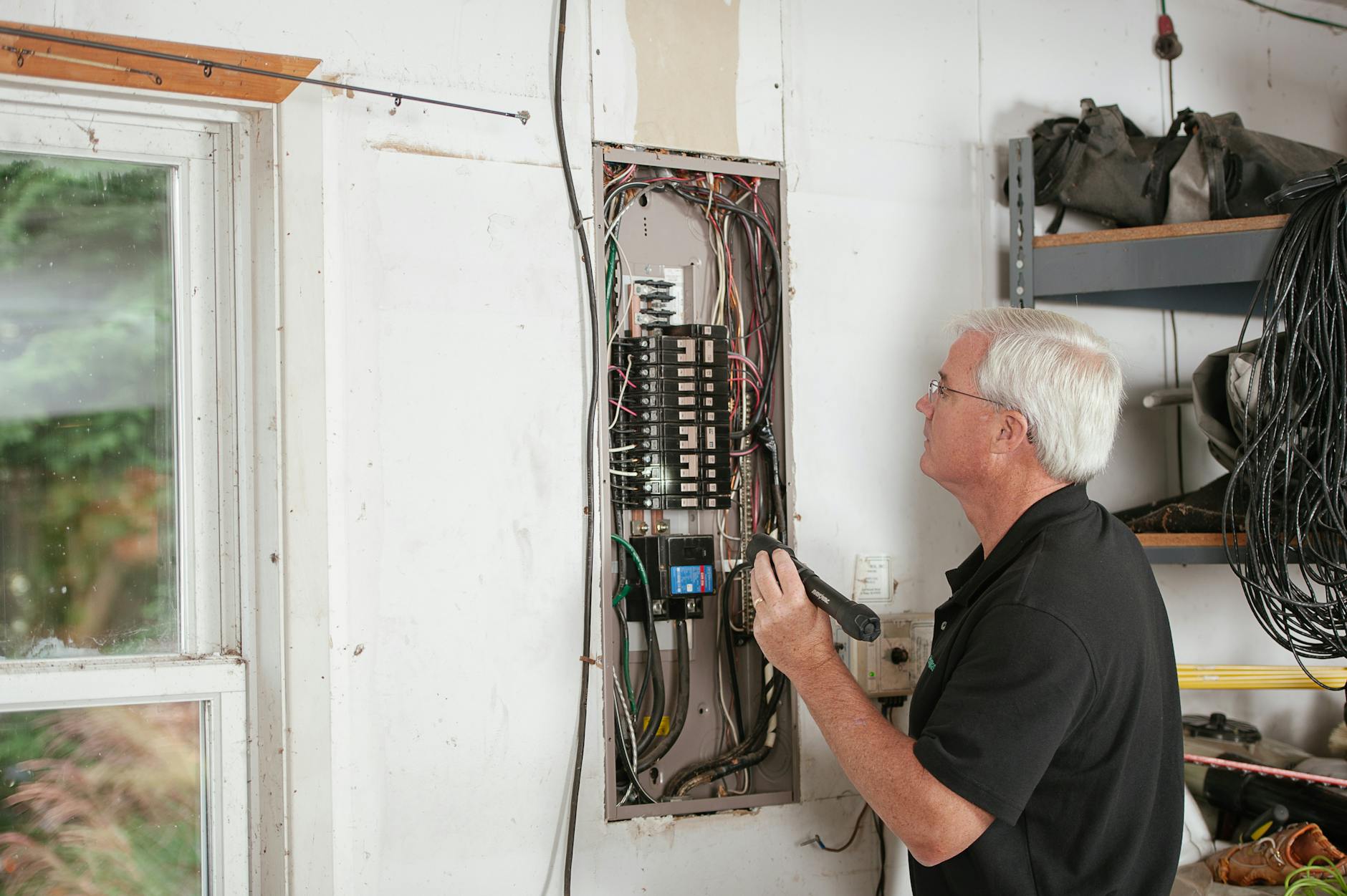
A DB board upgrade in Dubai is required whenever a distribution board is found to be non-compliant with DEWA's technical standards — whether during a new connection inspection, a re-energisation visit, or a routine compliance check. An overloaded or outdated board is not a paperwork problem. It is a fire risk. DEWA will not energise a property with a board that fails inspection, and the liability for a non-compliant installation sits with the property owner, not the authority.
What Is a Distribution Board (DB Board)?
The distribution board — also called a DB board, consumer unit, or fuse box — is the metal or plastic enclosure in your property that houses all circuit breakers (MCBs) and residual current devices (RCDs). Every electrical circuit in your villa or apartment originates here: air conditioning units, lighting rings, socket circuits, water heaters, kitchen appliances.
The board's function is twofold: distribute incoming electricity supply across multiple circuits, and protect each circuit with an overcurrent device that trips on fault. A board that cannot perform either function correctly is not a minor deficiency. Every circuit in the property loses its protection, and the risk of cable overheating — and fire — rises sharply.
This is not a theoretical concern. A significant proportion of residential electrical fires in the UAE trace back to distribution boards where MCBs were either incorrectly rated, bypassed, or where the board itself had been modified without assessment by a competent person.
What Is DB Dressing — and What Is a DB Upgrade?
These two terms refer to different scopes of work, though they are often confused or used interchangeably by contractors and property managers.
DB Dressing
DB dressing is the organisation, documentation, and physical presentation of an existing distribution board to meet DEWA's technical standards and UAE Wiring Regulations. It does not involve replacing the board enclosure or the MCBs. A properly dressed DB includes:
- Circuit labelling: Every MCB and RCD clearly labelled to identify the circuit it protects — "Living Room AC Unit 1", "Kitchen Sockets", "Master Bedroom Lighting", and so on. An unlabelled board is a DEWA compliance failure and a practical hazard in any fault or emergency situation.
- Updated circuit directory: A printed or clearly written schedule of all circuits fixed inside the DB door. This must be kept current whenever circuits are added, removed, or changed.
- Proper cable management: Cables entering and leaving the board neatly routed, secured, and terminated at the bus bars. Loose cable runs, unsecured tails, or cables spliced inside the enclosure are non-compliant and a direct safety issue.
- Blank plates on unused slots: Any MCB slots not in use must be blanked off with manufacturer-supplied covers to prevent accidental contact with live bus bars.
- Phase identification (three-phase supplies): In three-phase installations, phases must be clearly identified and balanced where possible.
DB Upgrade
A DB upgrade involves replacing components within the board or replacing the board enclosure entirely. This is required when:
- MCBs are incorrectly rated for the cables they protect — a 32A MCB on a 2.5mm² cable is among the most dangerous configurations we encounter in older Dubai properties
- RCDs are missing on circuits that require them under current standards (bathroom circuits, kitchen circuits, outdoor circuits, and pool equipment)
- The board enclosure is damaged, corroded, moisture-affected, or too small to safely accommodate the property's circuits
- The property has had significant additional loads added (additional AC units, EV charging, additional kitchen equipment) that the original board was not designed to handle
- The board uses obsolete technology such as rewirable fuses or early-generation MCBs that no longer perform reliably
DEWA Compliance: Why It Is Not Optional
DEWA's technical standards for electrical installations — based on IEC 60364 and the UAE Wiring Regulations — require that all distribution boards meet specific requirements for safety, documentation, and accessibility. This is not advisory guidance. It is a condition of supply.
DEWA inspectors check distribution boards during:
- New connection applications: All newly completed properties require a DEWA inspection before electricity can be connected. A non-compliant DB board results in a connection refusal until deficiencies are rectified and re-inspected.
- Reconnection after supply disconnection: Properties disconnected for non-payment or at the owner's request require re-inspection before reconnection. Boards that were compliant at original connection may have deteriorated or been modified since.
- Following a reported electrical fault: Where DEWA attendance was required for an electrical fault — particularly any event involving tripping at the DEWA meter or upstream fuse — the DB board will be inspected as part of the fault investigation.
- Building compliance inspections: Older buildings and properties changing use or tenancy may be subject to compliance inspections by DEWA or the relevant municipality.
The consequence of a non-compliant board is straightforward: DEWA will not connect, reconnect, or approve electricity supply to a property with a distribution board that presents a safety risk. The property owner carries the liability. A tenant or previous occupant having modified the board does not transfer that liability — ownership carries responsibility for the installation's compliance.
The Most Common DB Compliance Failures in Dubai Properties
Based on electrical inspections across a broad cross-section of Dubai properties — apartments, villas, and commercial units — the failures we encounter most consistently are:
- Completely unlabelled boards: Extremely common in properties built before approximately 2010, and in properties where multiple tenants have come and gone without any electrical maintenance. Often the original labels were applied in a language the current occupant does not read, or were never applied at all.
- Oversized MCBs protecting undersized cables: A legacy of building services departments that replaced tripping MCBs with a larger rating rather than investigating the fault. A 32A MCB on a 2.5mm² cable will not trip before the cable overheats. This is a direct fire risk.
- Missing RCDs: Many properties built before 2010 do not have RCDs on bathroom, kitchen, or outdoor circuits. Current standards require them. Properties without RCDs on these circuits will fail a DEWA inspection.
- Moisture damage: DB boards located in poorly ventilated utility rooms or outside plantrooms in Dubai frequently show moisture ingress, corrosion at terminal connections, and in serious cases, arcing damage from corroded contacts. Corroded connections are a fire and fault risk.
- Unauthorised modifications: Previous tenants or owners adding circuits, changing MCB ratings, or splicing cables inside the board without engaging a licensed contractor. These modifications are not only non-compliant — they are dangerous because they are typically done without any assessment of the existing installation's capacity.
- Overloaded boards: Properties where multiple AC units, heat pump water heaters, or EV chargers have been added without the original board being assessed for capacity. An overloaded board does not just risk tripping — it risks sustained overheating at the incoming supply terminals.
The DB Upgrade and Compliance Process in Dubai
Any electrical work on a distribution board in Dubai — beyond creating a circuit directory — requires a DEWA-registered electrical contractor. This is not a recommendation. It is a legal requirement. A general maintenance handyman, regardless of how experienced, cannot legally carry out DB modifications, MCB replacements, or board upgrades. If something goes wrong with work carried out by an unlicensed person, the property owner's insurance position is significantly compromised, and DEWA will not accept work that cannot be certified by a registered contractor.
The process for a compliant DB upgrade in Dubai follows these steps:
- Electrical inspection and assessment: A DEWA-registered contractor inspects the existing board, tests MCB ratings against installed cable sizes, checks RCD presence and function, and documents all deficiencies.
- Scope of works and quotation: The contractor specifies exactly what needs to be rectified — labelling only, individual MCB replacements, RCD additions, partial board replacement, or full board replacement.
- DEWA permit application (where required): Full board replacement and circuit additions require a DEWA work permit before work commences. The contractor handles this application.
- Rectification works: The contractor carries out the approved scope of works.
- DEWA inspection and sign-off: For permitted works, DEWA inspects the completed installation and issues a completion certificate. This certificate is required for DEWA connection or reconnection approval.
DB Board Upgrade Costs in Dubai (2026)
Costs depend entirely on scope. A DB dressing exercise on a straightforward apartment board is a few hundred dirhams. A full three-phase villa board replacement with permit and inspection is a multi-thousand dirham project.
| Scope of work | Approximate cost (AED) | Notes |
|---|---|---|
| DB labelling and circuit directory | AED 300–600 | Labelling only; no component changes |
| MCB replacement (per MCB) | AED 80–180 | Including component cost |
| RCD addition | AED 200–450 | Per RCD added to existing board |
| Full DB board replacement (standard apartment) | AED 1,500–3,000 | Single-phase, standard capacity |
| Full DB board replacement (villa, three-phase) | AED 3,000–7,000 | Larger enclosure, more circuits, higher-rated components |
| DEWA permit and inspection fees | AED 400–1,200 | Varies by work type and property category |
A property owner who has received a DEWA non-compliance notice should not attempt to manage the permit and rectification process independently. A DEWA-registered contractor manages the permit application, the inspection scheduling, and the technical sign-off. Attempting to navigate DEWA's technical approval process without a registered contractor results in delays and, in most cases, additional costs.
What a Licensed Contractor Must Do — and What an Unlicensed One Cannot
The distinction matters practically, not just legally.
A DEWA-registered electrical contractor can: apply for DEWA work permits, carry out MCB replacement and board modification work, certify the completed installation as compliant, accompany DEWA inspectors during post-works inspection, and submit completion documentation for DEWA approval. They carry the liability for work carried out under their registration.
A general handyman — regardless of electrical knowledge or experience — cannot do any of the above. They cannot apply for a permit, cannot certify compliance, and cannot represent the property at a DEWA inspection. Work carried out without a registered contractor will not be accepted by DEWA, will void any relevant insurance on the property, and will leave the property owner personally liable for any fault or incident arising from that work.
The cost difference between a licensed contractor and a handyman for DB work is typically AED 200–500 on a standard job. The liability difference is not comparable.
Maintaining Your DB Board: What Proactive Looks Like
The most cost-effective approach to DB compliance is not remediation — it is prevention. An annual or biannual inspection by a licensed electrician covers:
- Terminal tightness check: Electrical connections loosen over time from thermal cycling — the repeated heating and cooling of cables under load. Loose terminals cause resistance heating, which accelerates cable degradation and can cause arcing at the connection point.
- MCB function test: Manually testing each MCB to confirm it trips correctly under test conditions.
- RCD test: Pressing the test button on each RCD to confirm correct trip response. This takes approximately 30 seconds per RCD and should be done by the occupant every six months regardless of professional inspection schedules.
- Visual board condition check: Checking for moisture ingress, corrosion, discolouration (which indicates heat), and any visible damage to cable insulation inside the board.
- Directory currency: Confirming the circuit directory remains accurate after any changes to the property's circuits.
This inspection is included in every True Guard annual maintenance contract as part of the scheduled electrical safety check. For properties not on an AMC, it can be arranged as a standalone inspection.
Frequently Asked Questions
DEWA refused to connect my new property because of the DB board. What do I do?
A DEWA non-connection notice will list the specific deficiencies found during inspection. Engage a DEWA-registered electrical contractor immediately — the contractor will review the notice, assess the board, carry out the required rectification works (obtaining a permit where required), and resubmit the installation for DEWA inspection. Do not attempt to manage this process directly with DEWA without a registered contractor, as the technical submission requirements are contractor-specific.
How do I know if my DB board needs upgrading or just dressing?
If the board's only issues are unlabelled circuits and a missing directory, dressing is sufficient. If MCBs have incorrect ratings for the cables they protect, RCDs are missing on required circuits, the board enclosure is damaged or moisture-affected, or the board cannot accommodate the property's current electrical load, a partial or full upgrade is required. A licensed electrical inspection will confirm which scope is needed.
Can I label my own DB board without an electrician?
Creating a circuit directory yourself is straightforward: switch off each MCB one at a time and note which lights and sockets go off, building a complete map of the board. However, any physical changes to the board — replacing MCBs, adding RCDs, modifying cable runs, or replacing the enclosure — must be carried out by a DEWA-registered electrical contractor. Labelling the exterior of MCBs with adhesive labels based on your own circuit mapping does not require an electrician.
Is a DB board upgrade required when adding a new AC unit to a Dubai villa?
Adding a new AC unit adds a new circuit, which requires an MCB to be installed in the DB board. This is electrical work requiring a DEWA-registered contractor. Whether the board needs a full upgrade depends on its current condition and available capacity. If the board is already near capacity, is non-compliant on other grounds, or does not have spare MCB slots, the upgrade becomes necessary as part of the same project.
How long does a DB board replacement take in Dubai?
The physical work on a standard apartment board takes 2–4 hours. A villa three-phase board replacement takes a full working day. The permit application and DEWA inspection scheduling add time to the overall process — typically 3–7 working days for permit approval, then scheduling the DEWA post-works inspection, which can add a further 3–10 working days depending on DEWA's current inspection load. Plan for a 2–3 week total timeline from instruction to final DEWA sign-off.
What happens if I ignore a non-compliant DB board in Dubai?
The consequences range from a DEWA supply refusal (no electricity until compliant) to insurance voiding in the event of an electrical incident, and in the most serious cases, fire risk from overloaded or incorrectly rated circuits. Property owners carry the liability for the electrical installation in their property. A non-compliant board that causes damage to a tenant's property or a third party places the owner in a very difficult legal and financial position.
What is the difference between an MCB and an RCD, and do I need both?
An MCB (Miniature Circuit Breaker) protects against overcurrent — it trips when too much current flows through a cable, preventing the cable from overheating. An RCD (Residual Current Device) protects against earth faults and electrocution — it trips within milliseconds when it detects current leaking to earth, which is what happens when a person contacts a live conductor. Both are required: MCBs protect cables and equipment; RCDs protect people. DEWA requires RCDs on bathroom, kitchen, outdoor, and pool circuits as a minimum.
Can a general electrician or handyman do DB board work in Dubai?
No. Any modification to a distribution board in Dubai — MCB replacement, RCD addition, circuit addition, or board replacement — must be carried out by a DEWA-registered electrical contractor. A general electrician or handyman without DEWA registration cannot apply for work permits, cannot certify completed work, and cannot represent the property at a DEWA inspection. Work carried out by an unlicensed person will not be accepted by DEWA and may void property insurance.